NatureOnYourScreen

|

|

Modelling ecology
Structure of the model
 The ecosystem simulation, as prepared by us, constitutes the basis of our project, with the help of which the behaviour of any given number of species
and any given complexity of food networks can be described. In the following sections we will present a sketch of our model's structure. We emphasize that
our program is a very general framework in which the description of various ecosystems can be achieved with the aid of a great number of different parameters.
By the setting of these parameters we can specify the members of the ecosystem and thus get to the specific cases.
The ecosystem simulation, as prepared by us, constitutes the basis of our project, with the help of which the behaviour of any given number of species
and any given complexity of food networks can be described. In the following sections we will present a sketch of our model's structure. We emphasize that
our program is a very general framework in which the description of various ecosystems can be achieved with the aid of a great number of different parameters.
By the setting of these parameters we can specify the members of the ecosystem and thus get to the specific cases.
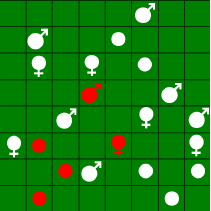
The operation of ecological systems is separated into area and time units, and a set of simple rules are introduced through which the complex operation of biological nature can be traced with computer science. The units of the square grid are divided into plains on the basis of species, and the individual animals are placed under scrutiny within them. The grid is endowed with periodical boundary conditions and the individuals of the species with the urge to move, increasing the chance of physical encounter. The given area is provided with producers, which constitute food supplies for the consumer population both directly and indirectly according to the predetermined parameters Consumer creatures are endowed with a general lifecycle independent of species, which each creature runs once by each time unit - accordingly, the observer may withdraw the data of the ecosystem on a time unit basis -.
Available cases
 Having the model successfully constructed and realistic, stable parameter configurations found, the next abstraction level is to test the most common
human effects on the ecosystem. One opportunity is the introduction of pesticides, which allows the user to reduce the number of a selected population instantly.
Pesticides as modelling tools enable the examination of numerous socially important cases, for example the agriculturally utilized pest reduction problem.
In our program two types of pesticides are distinguished: they can be either degradable or persistent. The former case represent the quickly dissolving chemicals,
the latter one stands for the ones with long-term effects and is often connected to biomagnification. The software with these attributes can represent an
abstract ecosystem, which can consist of any given number of trophical levels, and can reproduce well-known events of ecosystems or can even lead to new ecological discoveries.
Having the model successfully constructed and realistic, stable parameter configurations found, the next abstraction level is to test the most common
human effects on the ecosystem. One opportunity is the introduction of pesticides, which allows the user to reduce the number of a selected population instantly.
Pesticides as modelling tools enable the examination of numerous socially important cases, for example the agriculturally utilized pest reduction problem.
In our program two types of pesticides are distinguished: they can be either degradable or persistent. The former case represent the quickly dissolving chemicals,
the latter one stands for the ones with long-term effects and is often connected to biomagnification. The software with these attributes can represent an
abstract ecosystem, which can consist of any given number of trophical levels, and can reproduce well-known events of ecosystems or can even lead to new ecological discoveries.